


Lidl Plus Changes Explained: Will You Be Better or Worse Off?

The Points System Is Here, But Is It Actually Better for Your Wallet?
Lidl has made a significant change to its loyalty scheme, moving away from the reward structure most of us have grown used to. If you're a regular Lidl Plus user, you'll want to understand what's different and whether the new system actually works in your favour. The answer isn't straightforward, and it depends entirely on how you shop.
What's Actually Changing With Lidl Plus?

Lidl has scrapped its old Coupon Plus system and replaced it with a points-based model. The shift is more significant than it first appears because it fundamentally changes how you earn value and how much effort you need to invest to see returns.
Under the old system, you worked towards clear monthly spend targets and unlocked specific rewards once you hit them. Under the new system, you earn one point for every pound you spend in store, building a balance that you can exchange in the app for rewards of your choosing.
At first glance, it sounds like a standard loyalty scheme. In many ways, it is. You collect points and choose how to spend them, whether that's money off your shop or selected products in Lidl's rewards marketplace. But the key difference is that rewards are no longer handed out automatically at fixed milestones, and that changes how much value you can realistically extract.
This is Lidl moving away from a short-term reward model toward one that spreads value over time. You have more control, but you also need to spend more before seeing meaningful returns.
How the Old Lidl Plus System Worked
The previous system was simple and, for many shoppers, very rewarding. You had clear monthly targets, and once you hit them, you unlocked a fixed perk. Spend £10, and you'd get a free bakery item. Spend £50, and you'd unlock free vegetables. Spend £250, and you'd receive 10% off your next shop.
It was easy to understand and straightforward to plan around. If you knew you were close to a target, you might top up your shop slightly to unlock the reward. That behaviour was exactly what Lidl wanted, and for shoppers, it often felt like a genuine win.
There was also another layer to the system that savvy shoppers knew how to use. A free veg coupon didn't force you to pick the cheapest item, so many shoppers would go straight for the largest or best value product, such as a big bag of potatoes, stretching the reward far beyond its perceived value.
You were essentially choosing the reward within a category, which meant if you paid attention to what you chose, you could get considerably more out of the scheme than others who didn't read the small print!
How the New Points System Works

Under the new system, every pound you spend earns you one point. Those points can then be exchanged in Lidl's in-app marketplace for a range of rewards, including money-off coupons and selected products. Unlike the old system, nothing is lost if you don't hit a target.
Even a small shop contributes to your total, removing the all-or-nothing feeling many shoppers experienced before. Lidl has also confirmed that points can be saved for up to two years, giving you the option to build them up for bigger rewards later on.
There will also be bonus opportunities to earn more points, such as double points on certain items or limited-time promotions. These will likely play a key role in how much value you can extract from the scheme over time.
What Your Points Can Actually Buy: Real Examples
To give you a genuine idea of what you're earning towards, here's what items actually cost in points on the Lidl Plus marketplace:
Item | Points Required | Equivalent Spend |
Tin of baked beans | 40 points | £40 |
In-store bakery jam-filled doughnut | 50 points | £50 |
2-litre bottle of Lidl cola | 50 points | £50 |
Coffee drink | 70 points | £70 |
Spring onion | 70 points | £70 |
Bag of baby spinach | 115 points | £115 |
Pack of 3 onions | 95 points | £95 |
Iceberg lettuce | 90 points | £90 |
Cucumber | 100 points | £100 |
Plain tortilla wraps | 100 points | £100 |
Avocado | 90 points | £90 |
Blueberries (150g pack) | 160 points | £160 |
Raspberries (150g pack) | 215 points | £215 |
Grapes | 190 points | £190 |
Mixed peppers (3 pack) | 190 points | £190 |
Pink Lady apples (6 pack) | 275 points | £275 |
Protein-ready meal | 180 points | £180 |
Bag of cashew nuts | 180 points | £180 |
Seeded bloomer | 150 points | £150 |
In-store bakery pretzel | 60 points | £60 |
Tropical cross drink | 65 points | £65 |
Bottled water | 80 points | £80 |
Money-off vouchers | ||
£3 off next shop | 300 points | £300 |
£5 off next shop | 500 points | £500 |
As you can see from the table, even "simple" items like a single cucumber require 100 points (£100 spend), and fresh fruit like raspberries require 215 points (£215 spend). The most accessible rewards are tinned items and in-store bakery products, but even these require significant spending to unlock.
The Key Difference: Value Versus Flexibility
The biggest change here is not just how you earn rewards, but how much those rewards are actually worth.
Under the old system, you could unlock a free bakery item after spending £10. Under the new system, that same type of reward is expected to cost around 60 points, which would require roughly £60 of spend. That's a significant increase, highlighting the trade-off Lidl has made.
You now have more flexibility in choosing your rewards, but that flexibility comes at the cost of slower earning and reduced immediate value. Lidl has effectively moved from a generous, milestone-based system to a more controlled, long-term model. The difference can be pretty substantial, and it's worth calculating if you're trying to decide whether to keep using Lidl as much as you did before.
Why "Playing the System" Is Much Harder Now
One of the most overlooked changes is the loss of what many shoppers would call maximising or gaming the system (I prefer the term maximising the rewards on offer)
Previously, when you unlocked a reward like free vegetables, you could choose the most expensive or best value item available within that category. This meant you could stretch the reward and get more out of it!
You had the choice over which specific product counted as your "free" item, so if you got a free vegetable coupon, that could be exchanged for say a bag of carrots, or a massive 7.5kg bag of potatoes, and by having read their list of vegetables available within the deal, money savvy folks were always going to get the biggest, and/or most expensive they can, as its just make sense; I know I did!
With the new points system, rewards are tied much more closely to a fixed value. You are exchanging points for a defined benefit rather than selecting from a category with varying price points. This removes much of the opportunity to extract extra value from individual rewards.
In simple terms, the system is now fairer on paper, but much harder to beat in practice. The structure doesn't reward money-savvy/deal-aware shoppers in the same way the old system did.
Who Will Be Better Off Under the New System?
Not everyone loses out with this change, and for some shoppers, it may actually work better.
If you tend to shop little and often, or rarely hit your old monthly targets, the new system ensures that every pound you spend contributes to a reward.
Previously, you could miss out entirely if you fell just short of a threshold, which could feel frustrating when you were so close. I know, as an occasional Lidl shopper, this was something that happened to me a lot. Now, even a small top-up shop counts towards your points balance, which, for me, isn't a bad thing.
The ability to save points for up to two years also gives more flexibility, particularly if you want to build towards a larger reward or use your points during more expensive periods such as Christmas or back-to-school shopping. You're no longer racing against a monthly deadline, and less likely to miss out on a reward; equally, it may mean people who would go back to Lidl, instead of another retailer, just because they were close to getting a freebie, may well not go out of their way to go to Lidl.
I've personally done exactly that in the past, more than once; I've gone to Lidl as I was close to getting a freebie, and shopped there as I didn't like the idea of missing out on getting something for free, it's in my Penny Pincher nature, and that added money to Lidl's till, instead of a rivals, but now, with the new scheme, it's highly unlikely I'll be going out of my way to shop at Lidl.

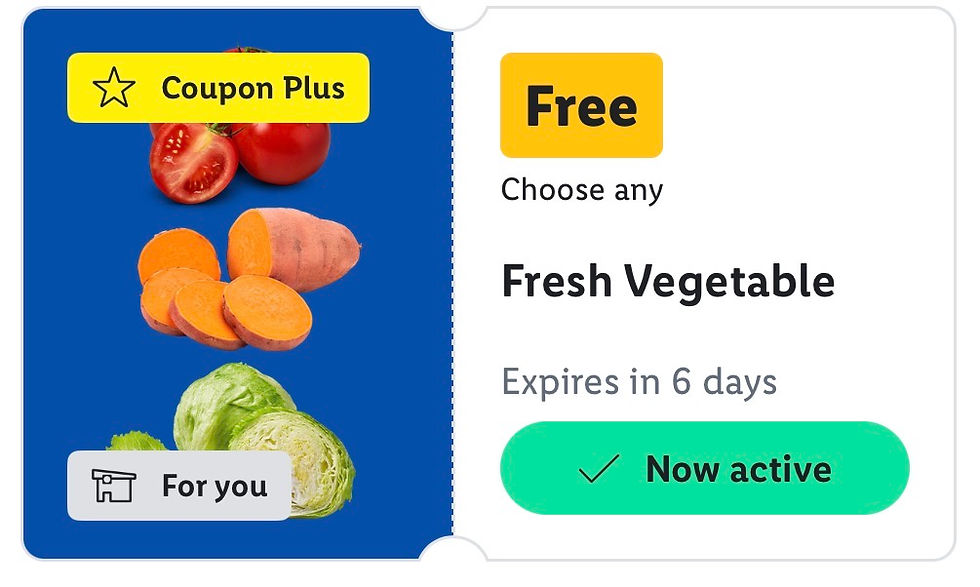
That said, I did get a coupon for a free bar of chocolate and a free vegetable item on my app on the new schemes launch day, as well as a welcome gift of 100 points! I'll go get those freebies and cash in the points for another freebie, but I likely won't actually buy anything else! A bit cheeky, I know!
Who Is Likely to Lose Out?
Shoppers who regularly hit the old targets are the ones most likely to feel the difference. If you were consistently unlocking rewards like the £10 bakery item or working towards the 10% off voucher, the new system will likely feel slower and less generous.
The removal of easy wins and high-value perks means that the overall return on your spending may be lower unless Lidl introduces strong bonus point promotions. Even then, those offers may require more effort and attention to fully benefit from.
For those who enjoyed squeezing as much value as possible out of the old system by choosing carefully within reward categories, this change represents a clear shift away from that opportunity. The "game" has fundamentally changed, and the old money-savvy strategies no longer work.
Is the New Lidl Plus Scheme Actually Better?
The honest answer is that it depends entirely on how you shop!
The new system offers more flexibility, more consistency, and removes the frustration of missing out on rewards entirely because you fell short of a target. At the same time, it reduces the speed at which you earn rewards and limits the ability to maximise their value through careful selection.
Lidl has effectively traded generosity for control over its customers' pace of earning rewards. You are less likely to get nothing, but you are also less likely to get a bargain or a freebie quickly. The pace of reward earning has slowed considerably, and the ceiling on individual reward value has been lowered.
For many shoppers, especially those who used Lidl Plus strategically, this will feel like a downgrade. You'll see rewards arrive more slowly and won't be able to unlock them through concentrated spending in a single month. For others who prefer a slower, more predictable system and who don't mind waiting longer for rewards, it may feel like an improvement because you're no longer penalised for missing targets by a few pounds.
My Honest Take: One of the Worst Changes in UK Supermarket Loyalty
Until this change, Lidl Plus was arguably one of the best supermarket loyalty schemes in the UK. You could start earning freebies without spending very much money, and regular shoppers saw genuine rewards quickly. Now, in my opinion, it's one of the worst schemes available, unless you hardly ever shop at Lidl.
If you're not a regular user, you probably won't lose out much. But if you've been using Lidl Plus to earn freebies a couple of times a month, you're not going to do well out of this new system. The change is dramatic enough to make a real difference to your budget.
What Lidl Customers Have Told me
I asked my Instagram followers what they thought about the new scheme, and the consensus was overwhelmingly poor. Not a single person said they were happy with the changes.
One follower pointed out the stark difference in value. They used to spend £250 a month and get 10% off their shop, which was significant to their food budget. Now, to get a £5 voucher, they'd need to spend £500. Meanwhile, spending 100 points gets them a £1 cheese twist. That's dramatically less impressive, and the maths speak for themselves.
Others said they'd always shopped at Lidl and were getting a lot less for their loyalty. They no longer feel the same incentive to keep shopping there and are actively considering alternative retailers. That feedback was consistent across multiple comments.
The underlying message from long-term Lidl Plus users is clear: this change makes the scheme feel like a downgrade rather than an improvement, and it's pushing people to question whether Lidl is still their best choice for supermarket shopping.
The Only Silver Lining
The one advantage the new scheme has is that points stay in your account for up to 2 years. This means you could potentially build them up over a longer period if you wanted to, rather than being locked into monthly targets.
For people who take very long breaks between shops or who want to save their points for a particular season like Christmas, this flexibility might offer some benefit. But for most regular shoppers, that's unlikely to offset the overall loss of value.
Why This Change Matters More Than You'd Think
It's easy to dismiss loyalty scheme changes as minor tweaks, but the Lidl Plus changes are significant because they remove one of Lidl's key competitive advantages.
Lidl and Aldi prices are often 'price-matched' by rivals such as Tesco, Sainsbury's, and Morrisons. For staple products, the prices are frequently identical across all these supermarkets. This means that on price alone, there's little to differentiate Lidl from its competitors. The baskets cost the same, the milk costs the same, the eggs cost the same.
Which? do a cheapest supermarket last month feature, (and we cover their findings on our blog as well) which is very useful to see which supermarket might be better for your food shop.
What kept customers coming back to Lidl, particularly those who were price-conscious and reward-focused, was the almost unbeatable Lidl Plus loyalty scheme. The old system offered genuine freebies and discounts that were hard to beat. Even if the prices were the same elsewhere, Lidl's rewards scheme gave you reasons to stay loyal and keep shopping there.
Now that the loyalty scheme has been significantly weakened, that incentive has largely disappeared. Customers who were in it for the freebies and discounts no longer have a compelling reason to choose Lidl over Tesco, Sainsbury's, or another supermarket. The price matching means they're paying the same for their groceries, but they're losing the rewards that made the difference.
This is potentially dangerous for Lidl. Without a competitive advantage on price or on rewards, shoppers are likely to drift towards other retailers, particularly those with their own loyalty schemes that might feel more generous. Multiple followers mentioned they're actively seeking alternative retailers, suggesting the damage has already begun.
The Cashback Alternative: Why Switching Makes Financial Sense
Another factor makes the Lidl Plus decline even more significant. Shoppers who switch to larger supermarket chains can benefit from UK cashback opportunities that simply aren't available at Lidl or Aldi.
Apps like JamDoughnut offer cashback on supermarket spending at retailers like Tesco, Sainsbury's, and Morrisons. Cashback rates vary depending on current promotions, but typically range from 2% to 5% depending on the supermarket and any active bonus offers.
Let's do the maths on one of my followers' situations. They used to spend £200 a month at Lidl to unlock a 10% off coupon, which equals £20 in savings. Now, if they switched that same £200 spend to Tesco and earned 4% cashback through JamDoughnut, they'd get £8 in cashback.
That's not as impressive as the old Lidl coupon on paper, but then they'd also receive Tesco Clubcard points, any active Tesco promotions, and other loyalty benefits on top. Combined, these could easily exceed the £8 and approach or match what they were getting from Lidl Plus.
The key difference is that cashback is immediately accessible and can be stacked. You get your 4% cashback, plus Tesco's loyalty rewards, plus any special offers running that week. With the new Lidl Plus scheme, you're looking at a much slower accumulation of points with fixed reward values and no flexibility to maximise value.
For shoppers spending £200 a month, the switch to another retailer with a cashback app isn't just about staying the same; it could mean coming out ahead. That's a pretty significant incentive, especially for budget-conscious families who've been loyal to Lidl specifically because of the rewards they were getting.
This adds another layer to why followers mentioned they're actively looking at alternative retailers. It's not just that the Lidl Plus scheme is weaker. It's that the alternatives are now more competitive, and when combined with cashback apps, they might actually deliver better value.
When I asked my Instagram and Facebook followers what they thought about the new Lidl Plus scheme, the general consensus was overwhelmingly poor. I didn't receive a single positive comment, and the pattern of complaints was remarkably consistent.
One follower who used to spend around £200 a month said they would easily earn 10% off their shop under the old system. Now, to get the same value, they'd need to spend £500 to earn a £5 voucher.
They're now getting £1 worth of cheese twists for their loyalty, instead of more meaningful discounts; the difference in what they receive is dramatically less impressive.
Multiple followers said they've always shopped at Lidl regularly and are now getting considerably less for their loyalty. They no longer feel the same incentive to keep shopping there and are actively considering alternative retailers.
Several mentioned feeling that the scheme no longer rewards their consistent spending in the way it used to, which has decreased their willingness to stay with Lidl as their primary supermarket choice.
The overwhelming message was that people feel let down by the change. For regular, high-spending shoppers, the shift from achievable monthly rewards to a slow points accumulation system has fundamentally changed how attractive Lidl feels as a shopping destination.
The only silver lining people mentioned was that points stay on your account for two years, so theoretically, you could build them up over time. However, even that wasn't enough to offset the disappointment about how long it now takes to earn meaningful rewards.
This change marks a fundamental shift in how Lidl wants customers to engage with its app. Instead of encouraging shoppers to chase monthly targets and plan their spending around hitting milestones, it now rewards consistent spending over time. The focus has moved from intensity to consistency.
That might suit Lidl's long-term strategy, but for shoppers, the impact will vary significantly depending on their habits. The key is understanding how the new system works with your shopping patterns and adjusting your engagement with the scheme to get the most out of it.
If you were relying on those quick, easy wins to stretch your budget, you may need to rethink your approach to the app. If you prefer a steady build-up of rewards over months rather than chasing monthly targets, you might find it works better for you.
Either way, it's a change worth paying attention to because it will affect how much you get back from every shop, and during a cost of living crisis, where food prices are going up steadily, and don't look like thier going down ay time soon, people are shopping in a more money savvy manner, and this may mean that they'll be revaluating where they now shop, and for Lidl, it might not work in their favour..
FAQ's
Q: How many points do you earn with Lidl Plus?
A: You earn 1 point for every £1 spent in store. Lidl may also offer bonus points through promotions on selected products or during specific periods, so it's worth checking the app regularly for double points opportunities.
Q: Do Lidl Plus points expire?
A: Points can be saved for up to two years before they expire. This gives you flexibility to build them up over time or wait for larger rewards rather than cashing them in immediately.
Q: Can you still get free items with Lidl Plus?
A: Yes, but instead of unlocking them through spend targets, you'll need to exchange points for rewards through the app. The value of those rewards is now fixed rather than flexible, so you can't choose expensive items within a category the way you could before.
Q: Is Lidl Plus still worth using?
A: It depends on your shopping habits. If you shop regularly but in small amounts, every pound now counts, so you may see a benefit. If you were someone who hit the old targets easily and consistently, you may find the rewards take longer to earn and feel less generous. It's worth calculating the points you'd earn on your typical weekly shop to see if it's worthwhile for you.
Q: Will Lidl bring back the old target-based system?
A: There's no indication that the old system will return. The points system appears to be Lidl's long-term direction for its loyalty scheme, so it's worth adapting your approach rather than waiting for a reversal.


