


Your First Home Scheme: What a 2.5% Deposit Could Mean
By Al Baker | Founder & Editor, The Penny Pincher - Last checked: 30th of September 2026.
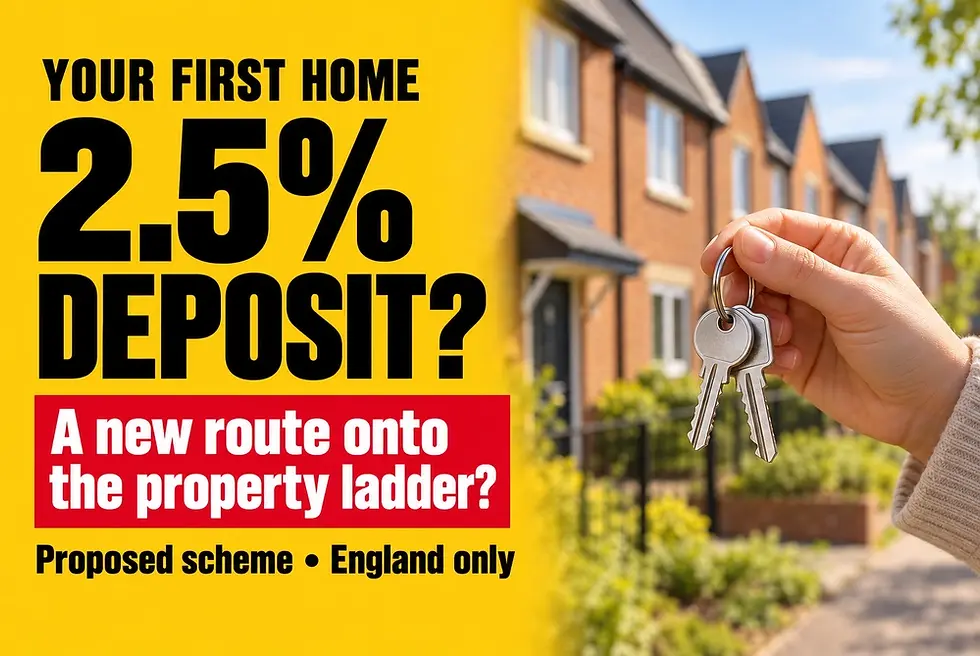
Saving a deposit can be one of the hardest parts of buying your first home, especially when rent and everyday bills leave little spare money each month.
The announced Your First Home scheme could reduce the deposit needed by eligible buyers in England to 2.5% of the property price. It would also involve a government-backed equity loan, so a smaller deposit wouldn’t mean the rest of the home comes free or that you’re guaranteed a mortgage.
This guide covers an announced England-only scheme whose full rules and application timetable haven’t been confirmed. It provides general information, not a mortgage recommendation or a promise that you’ll qualify.
How could the 2.5% deposit work?
The proposed scheme would combine a 2.5% deposit with a 20% government-backed equity loan. It would be for prospective first-time buyers purchasing new-build homes from developers signed up to the scheme. That leaves 77.5% of the purchase price to cover with a mortgage in the illustration below, assuming those proposed proportions are used.
On a £250,000 property, 2.5% is £6,250, while 20% is £50,000. The remaining £193,750 would be the mortgage, before considering any separate fees and the lender’s assessment. These figures show how the percentages fit together; they aren’t a mortgage quote, and a £250,000 home won’t automatically be eligible under the final local price limits.
For comparison, a 5% deposit on a £250,000 home is £12,500, which is £6,250 more than a 2.5% deposit. That difference could reduce the amount someone needs to save upfront. It doesn’t remove legal costs, moving costs or any other charges that apply to the purchase, so your deposit shouldn’t be your entire buying budget.
What is a government equity loan?
An equity loan is borrowing connected to a share of a property’s value, rather than money you’re given to keep. With this type of arrangement, the repayment can depend on what the home is worth, so you shouldn’t assume the original cash amount is all you’ll ever need to repay. The exact Your First Home repayment rules still need to be published, including how valuations and changes in property value would be handled.
The equity loan would have an initial interest-free period, but its length and the charges that would apply afterwards haven’t been confirmed. Interest-free also doesn’t mean the loan itself disappears. You’ll need to understand both the mortgage and the equity loan before deciding whether the combined commitment is affordable.
Who could qualify, and which homes would count?
The proposal is aimed at first-time buyers in England buying a new-build property from a participating developer. A household income cap and local property-price caps are part of the proposal, but the amounts haven’t been announced. Don’t assume that every first-time buyer, every new-build development or every home at a particular price will qualify.
The proposed scheme is limited to England and new-build homes, and having a small deposit won’t guarantee mortgage approval. You’ll still need to consider your income, debts, regular spending and the ongoing costs of owning the property. Once participating lenders and full rules are available, a suitably qualified mortgage adviser can help you compare the scheme with other options for your circumstances.
When can you apply for Your First Home?
Further details, including costs and the timetable, are due at the Budget. The Budget takes place on the 28th of October 2026. That’s the date to look for the detailed rules, rather than treating the announcement itself as an open application service.
There isn’t a confirmed application process in the official information checked for this guide. Don’t pay someone to reserve a place based only on the announcement, or assume a developer’s expression-of-interest form means you’ve been approved. Wait for the published scheme route and check what any reservation payment would commit you to before handing over money.
What can you do while the details are being worked out?
Keep working on the part you can control: how much you can save and what monthly housing costs your budget could support. Allow for bills, maintenance and, where relevant, service charges as well as the mortgage payment. MoneyHelper’s explanation of mortgage repayments can help you understand the difference between repaying the borrowing and paying interest on it.
If existing repayments are already making your budget difficult, our guide to dealing with debt is a useful starting point before taking on a home loan. A smaller deposit won’t solve a monthly affordability problem, and cashback or a small promotional reward shouldn’t decide a mortgage choice. Compare the overall borrowing costs and terms once actual products are available.
Put a reminder in your diary for the 28th of October and use the confirmed rules to revisit your budget. The next useful comparison will need the income cap, local price limit, equity-loan charges and a mortgage quote you could actually obtain. Until then, treat the 2.5% figure as a proposal to plan around cautiously, rather than a reason to commit to a particular home.
Frequently asked questions
Is the Your First Home scheme open for applications?
The official information checked on the 30th of September 2026 doesn’t provide an open application process. Further details and the timetable are due at the Budget on the 28th of October.
How much is a 2.5% deposit on a £250,000 home?
A 2.5% deposit is £6,250. Under the proposed 20% equity-loan structure, that would leave a £50,000 equity loan and a £193,750 mortgage, before other buying costs.
Is the government equity loan free money?
No, it’s borrowing that will need to be repaid under the scheme’s terms. The initial interest-free period and later charges haven’t yet been confirmed.
Can I use the scheme for any property?
The proposed scheme covers new-build homes in England from participating developers. Local property-price limits will apply, but those limits haven’t been published yet.
How much can I earn and still qualify?
A household income cap has been announced, but the amount hasn’t been confirmed. You’ll need to check the final eligibility rules and satisfy the mortgage lender’s requirements.