Energy Efficient Front Doors: What Actually Keeps a Hall Warm?
Updated: 2 minutes ago
This article has been published as part of an advertising collaboration 0 Edited by The Penny Pincher - Last Checked 26th November 2026
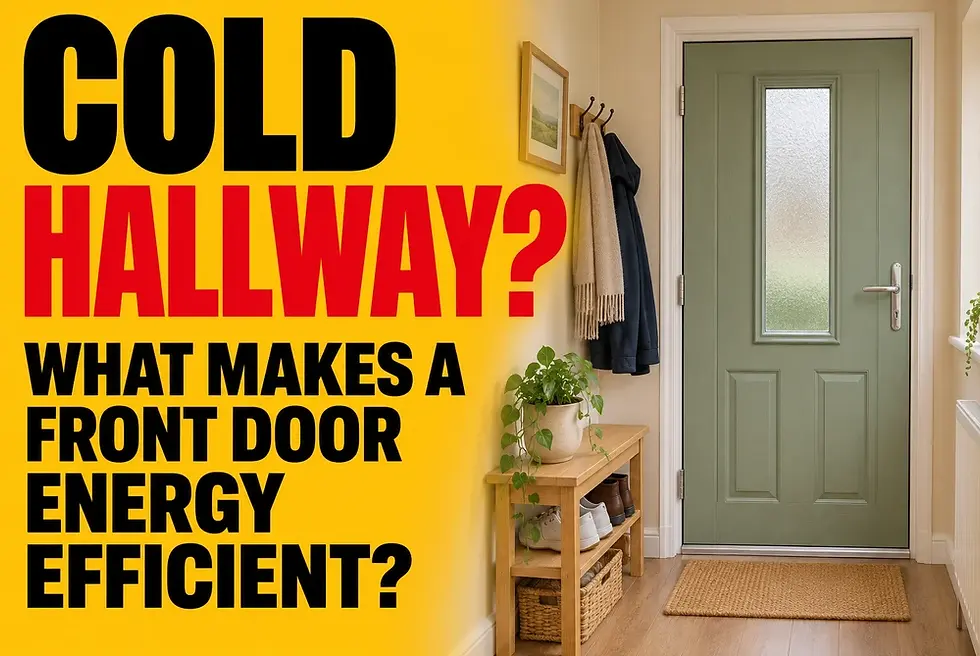
A cold hallway is a familiar complaint in British houses, and the front door usually gets the blame.
Sometimes rightly, as an old solid timber door can let through several times as much heat as a modern insulated one. Heat passes through the door itself, and cold air slips in round its edges, through the letterbox and under the threshold. A new door with an excellent rating can still leave a draughty hall if it’s badly fitted, and an old door can be made far less draughty without being replaced.

So what do energy efficient front doors actually buy you on a cold night? A door’s U-value can tell you how much heat escapes through it, and why the first upgrade does most of the work. Here’s how to spot where the draught is coming from, what the Building Regulations ask of a replacement and how five doors compare, from Latham’s steel front door to Hörmann’s ThermoCarbon.
What a U-value tells you
A U-value measures how much heat passes through one square metre of a door for each degree of difference between inside and outside, in watts per square metre per kelvin (W/m²K). The lower the figure, the less heat escapes. Because the figure changes with the size of the door and the amount of glass, ask for the U-value of the door, glass and frame you’re actually buying.
The first upgrade does most of the work

The heat lost through a door is its U-value multiplied by its area and the temperature difference across it. Take the 1.23m by 2.18m door in the chart, with the hall at 20°C and the outside at 0°C. An old solid timber door with a U-value of 3.0 lets through about 161 watts, against 54 watts for a door rated at 1.0. That single step captures about four-fifths of the saving available in this example. Going from 1.0 to 0.47 brings the heat loss down to about 25 watts.
The jump that matters most is from an old, uninsulated door to a well-insulated one. Beyond that point, the differences between good doors are small. If you’re choosing between two with similar figures, security, fitting and looks may count for more.
Where heat really escapes from a front door
The U-value tells you how much heat passes through the door and frame. If you can feel cold air moving, there’s also a gap to find. Where you feel it can tell you which fix is worth trying.
Two places to check on a new door are the joint between the frame and the wall, and the seals around the opening. A frame fixed out of square means the seals don’t press evenly when the multipoint lock engages. Cold air can still find its way through that gap.

What the Building Regulations ask
In England, the usual standard for a replacement front door in an existing home is a U-value of 1.4 W/m²K or lower. Table 4.2 of Approved Document L, Volume 1, also accepts a Doorset Energy Rating of band B or better, or band C or better if more than 60% of the inside face is glass. For a like-for-like replacement, GOV.UK says you don’t need to apply for building regulations approval if less than half the door is glazed. Where approval is needed, a registered competent person can certify work covered by their scheme.
You may still see 1.8 quoted for timber doors. A temporary allowance let them reach 1.8, or band E, until 14th June 2023. External fire doorsets have a separate allowance of 1.8, while new homes in England are covered by a different table, which sets a limiting U-value of 1.6 for doors. Wales, Scotland and Northern Ireland publish their own guidance.
Does the material matter?
Less than you might expect. The warmth of a modern door comes mainly from its insulated core and its frame. Steel, aluminium and composite doors can all be built as insulated sandwiches, and good examples reach about 1.0 or better. Wood insulates better than metal, but a solid timber leaf without an insulated core rarely matches a modern insulated door. With a metal frame, look for a thermal break, an insulating section between the outside and inside faces. Without it, the edges of the door can run cold even when the leaf is excellent.
Glass costs warmth, so ask for the whole doorset figure
Glass usually lets through more heat than an insulated leaf. Spitfire publishes both figures for its S-100 doors, at 0.77 for solid designs and 0.88 for glazed ones. That’s about 14% more heat passing through the glazed design at the same size and temperature difference. Sidelights and toplights add more glass and more frame, so ask for the U-value of the whole doorset on your quote. If you want light in the hall, triple glazing can narrow the gap.
Fixing a cold hall: the order that pays
If warmth is the main goal, work from the cheapest fixes up. Draught-proof the existing door with new seals where they’re worn, a brush or flap behind the letterbox, a keyhole cover or a threshold seal where the wind gets underneath. Check the frame-to-wall joint for gaps as well.
Replacement makes more sense if the door is uninsulated, warped or failing. A doorset at about 1.0 and a careful installer will get you most of the improvement shown in the chart. Before paying more for a lower figure, look beyond the door.
The Centre for Sustainable Energy puts the average saving from new windows and doors together on a semi-detached house at about £140 a year. A door alone can cost more than £1,000, and you can’t count that whole £140 against it. If the loft or walls still need insulating, your money may go further there.
Five energy efficient front doors with published figures
1. Latham’s High Security Front Door for warmth and security

The Latham's High Security Front Door wraps a CFC- and HCFC-free foam core in a 63mm galvanised steel leaf, hung in a steel-reinforced uPVC frame, with laminated triple glazing on glazed designs. Latham’s quotes a U-value of 0.9 W/m²K. The doorset is also Secured by Design certified and PAS 24 tested, with a Winkhaus multipoint lock and three-star cylinders, so warmth and security come in one doorset, made to measure in the UK.
2. Hörmann ThermoCarbon for low-energy builds
Hörmann’s ThermoCarbon has the lowest whole-door figure in this comparison, with a U-value as low as 0.47 from a 100mm insulated leaf with a carbon and glass-fibre reinforced profile. It comes with RC3 burglar resistance as standard and RC4 as an option. It suits a new build or deep retrofit where the specification calls for particularly low heat loss. Hörmann sells through dealers who can survey and fit.
3. Spitfire S-100 for a bespoke modern entrance

Spitfire publishes two figures for its S-100 series, 0.77 for solid designs and 0.88 with glass, which makes the cost of glazing visible. The S-100 has a steel leaf in an aluminium frame and is tested to RC2 and PAS 24. The heavier S-500 series lists RC3 and PAS 24 at a U-value of 0.6 to 0.9 depending on the design.
4. Urban Front for architect-led timber and steel
Urban Front’s hinged steel door is rated at about 0.7, with RC3 security testing and five-point hook locking. On the timber side, its e80 hinged specification gives 1.112 for the door leaf and the e98passiv sheet gives 0.82 for the insulated leaf in an unglazed design. If you’re comparing a timber quote with another maker’s whole-door figure, ask Urban Front for the value with the frame included.
5. Klöeber KlassicFront for period houses in real timber
Klöeber’s KlassicFront is a raised-panel door in engineered Red Grandis or Accoya timber, made to your exact size and panel layout. It has U-values down to 1.0 and multipoint locking, and Klöeber says the door has been tested to exceed Secured by Design standards. It suits a period cottage or Victorian terrace where the panels should match the original.
FAQs
What U-value should a new front door have?
In England, 1.4 W/m²K or lower is the usual standard for a replacement front door in an existing home. A Doorset Energy Rating of band B or better is an alternative, or band C if more than 60% of the inside face is glazed. Several of the modern doors in this guide reach about 1.0 or lower.
Can a high security door also be energy efficient?
Yes. The insulated core that keeps heat in can sit inside the same steel or aluminium leaf that resists attack. Latham’s steel front door, for example, combines a published U-value of 0.9 with PAS 24 security testing.
Is a new front door worth it for energy savings alone?
Rarely on its own. In the example above, replacing a door rated at 3.0 with one rated at 1.0 cuts heat loss through that door by two-thirds. Draught-proof first, and consider replacement if the door is also warped or failing on security or condition.
What is a Doorset Energy Rating?
It’s a label, like an appliance energy label, that grades the whole door and frame on energy performance. The British Fenestration Rating Council’s scale runs from A++ down to E. In England, Approved Document L accepts band B for a replacement door in an existing home, or band C if more than 60% of the inside face is glazed.
Why is my hall still cold after fitting a new door?
If you can feel a draught, check the letterbox, the threshold and the seals around the door. A gap between the frame and the wall can also let cold air in. Ask the installer to check the frame is square and the seals press evenly when the door is locked.