

My Monzo for kids review: is the free Under 16s account worth it?
Updated: Sep 12
How does the free Monzo Under 16s account work?
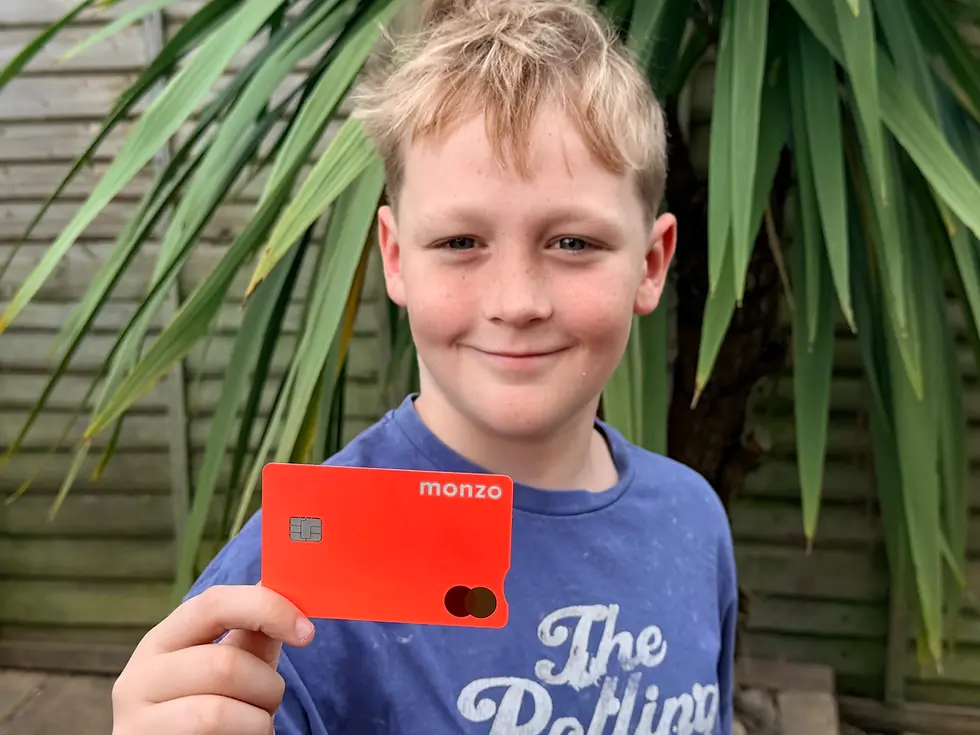
Monzo for kids, officially called Monzo for Under 16s, is a free account for children aged 6 to 15 that sits alongside a parent or legal guardian’s Monzo current account. The child gets their own debit card and can use a child-friendly version of the Monzo app, while the adult can see their spending, set limits and move money into the account.
We use it fior my 9 year old son and the14 year old boy we are foster carers for, so this Monzo for kids review is based on how the account works in everyday use rather than the feature list alone.
There is an important distinction between this and a bank account held legally by the child. With Monzo Under 16s, the parent or guardian is the account holder and legally owns the money, even though the child has access to the card and app. That makes it useful for managing pocket money and everyday spending, but it is something to understand if you are looking for somewhere to hold significant long-term savings in the child’s own name.
For us, one of the biggest advantages is that the children can have some independence without us losing sight of what is happening. They can pay in shops, see what they have left and start making their own choices, while I can see the same transactions from my phone. It has also given us a practical way to talk about spending and saving using real purchases rather than trying to explain money only in theory.
How does the free Monzo Under 16s account work?
Monzo Under 16s is linked to the adult’s existing Monzo current account, so you need to be a Monzo customer before you can open one. You add the child’s account from within your own app, provide their details and order their debit card, while the child doesn’t need photo ID, proof of address or even their own phone. If they have a suitable device, you can give them access to the child version of the Monzo app as well.
The adult remains responsible for the account and can see the child’s activity, set a daily spending limit and control whether online payments, contactless payments and cash withdrawals are available. The child can check their balance and transactions, use Pots, set savings goals and freeze their card if it goes missing. They can’t arrange bank transfers to other people, borrow money or take out an overdraft.
Monzo currently allows an Under 16s card to spend up to £250 a day and withdraw up to £100 a day from a cash machine, although the parent can set lower limits. Payments will normally be declined when there isn’t enough money available, with some exceptions for delayed or offline transactions. If an offline payment pushes the balance below zero, Monzo says it can move money from the adult’s current account to bring the Under 16s account back to zero.
What is Monzo for kids like to use as a family?
We currently use the account for the 2 children, and in practice it has become a fairly normal part of how we manage their money. Pocket money can go into the account, they can use their own cards when they are out, and we can see what remains without having to keep track of cash. I’ve found that seeing the balance change after a purchase also gives us something concrete to refer to when we talk about what they spent and what they still have available.
I also like being able to transfer money quickly when one of them needs it. There are times when the older child is already out and needs money for a drink, food or something else we have agreed to, and I can move it across without them needing to carry extra cash from home. That flexibility has been particularly useful for the child, to give more independence as he is regularly making small purchases for himself.
The visibility works both ways, because I can see purchases and I also see when payments are declined. That doesn’t mean every declined transaction signals a problem, as I’ve found that the way a retailer is categorised can sometimes be the reason. It does give us an opportunity to understand why something has happened rather than the child simply seeing a card refuse to work.
How do you put pocket money onto a Monzo kids card?
You can move money from your own Monzo account into the Under 16s account as a one-off payment or schedule regular pocket money. We usually add money manually because that suits the way we manage it, but a weekly or other regular transfer can be set up if you prefer the same amount to arrive automatically. Money can also be moved back to the adult account by the main account holder when needed.
The child doesn’t receive their own standard sort code and account number for other people to use. Instead, Monzo lets the parent or guardian create a secure payment link, which can be shared with friends or family who want to send birthday money or another gift directly to the child’s balance. The sender can use a UK debit card and doesn’t need to have a Monzo account themselves. Payments are made via Apple Pay and other mainstream banking systems.
There is a limit worth knowing about before sending the link to a large group of relatives. An Under 16s account can currently receive a total of £250 through payment links during a rolling 30-day period, and a non-Monzo customer can send a maximum of £100 in one payment. If more money needs to be added, it can be sent to the adult first and then transferred into the Under 16s account.
Can you see what your child spends?
Yes, the main account holder can see the child’s balance and transaction activity from their own Monzo app. If notifications are switched on, Monzo sends an alert when the child spends, which means you don’t need to wait for a statement or ask the child to show you their phone. The child can see their own spending as well if they use the app.
That has been one of the features I use most. I’m not checking every payment because I expect something to be wrong, but having the information there means we can discuss a purchase while it is still relevant. It also means that, as the children become more independent, I don’t have to choose between giving them a card and having no idea how it is being used.
The account still needs to be used as part of a wider conversation about money rather than as a surveillance tool. A spending notification can tell you where the card was used, but it can’t tell you whether a purchase was sensible or whether the child understood the choice they were making. I find it more useful as a way of supporting those conversations than simply policing what has been bought.
What spending controls does Monzo for kids have?
Parents can set a daily spending limit and switch online payments, contactless payments and cash withdrawals on or off. Monzo also applies automatic blocks to certain merchant categories that it considers unsuitable for children, including betting and gambling businesses. These category restrictions are separate from the spending controls that the adult can change.
The distinction matters because the automatic blocks rely on merchant classification rather than knowing exactly what the child is trying to buy. Monzo acknowledges that a transaction can occasionally be blocked incorrectly because of the way a business has been categorised. It also points out that a card-category block can’t stop an age-restricted item being purchased from a general retailer such as a supermarket.
We’ve experienced the first problem ourselves. Some gaming-related purchases have been declined, and our foster child has also had the card refused when trying to buy an ordinary drink from a shop registered as an off-licence. The purchase itself wasn’t the issue, but the merchant category was enough to stop the payment.
What happens when Monzo blocks a legitimate purchase?
There doesn’t appear to be a parent setting that lets you approve a single shop while leaving an automatic blocked category in place. In our case, that meant we couldn’t simply allow the off-licence transaction because we knew the child was only buying a soft drink. The practical answer has been to use a different shop when that happens.
I don’t see that as a reason to stop using the account, but it is a limitation I would want to know about before relying on the card for every purchase. A teenager travelling or away from home could find it frustrating if a café, entertainment venue or shop has been assigned a merchant category that Monzo blocks. Monzo’s own community contains reports from other parents who have encountered similar problems at places where their children were trying to buy ordinary items.
For us, I would rather understand that the blocks can sometimes be over-sensitive than assume the card will work everywhere. The important point is that these merchant-category restrictions are set by Monzo, while controls such as online payments and cash withdrawals can be managed by the adult. That difference wasn’t particularly obvious to me until we encountered a declined transaction ourselves.
Can Monzo for kids help children learn about money?
A children’s account can provide a practical setting in which to start learning about spending, saving and checking a balance. Monzo gives the child access to their transactions and Pots, while the adult can remain involved and set limits where needed. The child is dealing with real money and real purchases, rather than a simulated budgeting exercise.
I’ve found that useful in our household because the children can make smaller financial decisions for themselves. If money is spent, they can see the effect on what remains, and if they want something more expensive they can move money aside towards it. We still need to talk about those choices, but the account gives us something practical to work with.
That matters even more as a young person gets closer to adulthood. Knowing how to use a debit card, check a balance, separate spending money from savings and understand that a balance has limits are all everyday financial tasks. Giving a child room to practise those things while an adult can still help is one of the main reasons we continue to use the account.
Can children save money with Monzo?
Yes, Monzo Under 16s includes Pots and now also has separate savings accounts for children. Pots allow money to be separated from the main spending balance and can be locked by the parent until a chosen date. Monzo currently allows up to 20 savings accounts and Pots in total for each Under 16s account.
When checked on the 10th of August 2026, the Monzo Under 16s savings account paid 2.75% AER variable, with interest calculated daily and paid monthly. Monzo sets a £10,000 maximum savings balance per child, and both the child and the main parent or guardian can normally withdraw from an unlocked savings account. Rates are variable, so this figure should be checked again when the post is updated.
There is an unusual ownership point to consider. Monzo says the interest earned belongs to the main parent or guardian because that adult legally owns the account, and it will normally count towards that adult’s taxable income. If the aim is to build substantial savings that legally belong to the child, compare dedicated children’s savings options separately rather than assuming the Under 16s spending account is designed for every purpose.
Can foster carers open a Monzo account for a foster child?
Monzo’s published eligibility says the main account holder must be the child’s legal parent or guardian. That creates a point of uncertainty for foster carers, because fostering arrangements don’t all give the carer the same legal status or parental responsibility. I wouldn’t assume that being an approved foster carer automatically satisfies Monzo’s published requirement.
Our own experience was positive, but it should be treated as our experience rather than a rule that will apply to every placement. Monzo asked us to verify our relationship to the child, and we provided a letter from our local authority confirming our position as foster carers. Monzo accepted that evidence and we were able to set the account up.
If you are fostering and want to use Monzo Under 16s, I would check with both Monzo and your fostering service before planning around it. Explain your legal relationship to the child and ask Monzo what evidence it requires for that particular arrangement. That removes the risk of assuming our experience will be repeated in a different placement.
Our own application was also easier than I expected. We completed the process online, uploaded the documentation Monzo asked for and didn’t need to speak to anyone directly. We already had the supporting letter from our local authority confirming that the child was in our care and explaining our relationship to them, and Monzo accepted that evidence without any problems.
At that point, we hadn’t yet been through fostering panel or completed the formal approval process as foster carers, as we were still being assessed. Even so, we were caring for the child under a local authority arrangement, and the documentation provided by the council was enough for Monzo to approve the Under 16s account in our case. I’d still treat that as our own experience rather than a guarantee that every foster or kinship arrangement will be accepted in exactly the same way, but for us the whole process was completed online and was very simple.
What happens when a child turns 16?
A child using Monzo Under 16s can apply for their own Monzo 16 to 17s account once they reach 16. That new account belongs to the young person rather than the adult, comes with its own account number and sort code, and has restrictions on areas such as gambling and overdrafts. They need suitable photo ID, their own UK mobile number and an email address to apply.
Moving at 16 isn’t compulsory. Monzo says the existing Under 16s account can continue until the young person turns 18, which gives the family time to decide when greater independence is appropriate. If they do open the 16 to 17s account, access to the old Under 16s account ends after the new card is activated.
At 18, a Monzo 16 to 17s account automatically becomes a standard Monzo current account and the remaining age restrictions are removed. The money, card details and spending history carry across rather than requiring another application. That creates a route from a closely managed children’s card towards an account the young person controls independently.
Is Monzo for kids completely free?
Monzo Under 16s has no upfront charge, subscription fee or top-up fee, which is one of its strongest advantages against paid children’s cards. The child gets a debit card and access to the account features without the adult paying a monthly charge for each child. You do need your own Monzo current account, which may be a consideration if you don’t already bank with Monzo.
Free doesn’t mean that every possible cost is £0. Monzo’s current terms say a replacement card can cost £5 when a child loses or damages it, while replacements for reasons such as expiry, a faulty card, theft or a card retained by an ATM can be free. An overseas replacement can carry a separate charge, so check the current terms if a card is lost while travelling.
Money held in the Under 16s account is covered through the main adult account holder’s Financial Services Compensation Scheme allowance. The current FSCS deposit limit is £120,000 per eligible person, per authorised firm, and the child's Monzo balance forms part of the adult’s total allowance across their eligible Monzo accounts rather than receiving a separate £120,000 limit of its own.
How does Monzo for kids compare with other children’s cards?
Monzo isn’t the only low-cost option for giving a child a debit card and parental controls. Starling Under 16s is also free and is connected to an adult Starling account, while GoHenry is a separate prepaid card and app with more structured money-learning features but a monthly charge. Which is better depends partly on where the adult already banks and which features the family will actually use.
Prices checked on the 10th of August 2026.
Feature | Monzo Under 16s | Starling Under 16s | GoHenry Everyday |
Monthly cost | Free | Free | £3.99 per child |
Age range | 6 to 15 | 6 to 15 | 6 to 18 |
Adult needs provider current account | Yes | Yes | No separate bank current account required |
Product structure | Account held by parent or guardian | Space linked to adult Starling account | Prepaid debit card and app |
Child app access | Optional | Optional | Yes |
Parent spending controls | Yes | Yes | Yes |
Regular pocket money | Yes | Yes | Yes |
Money from friends and family | Payment link | Payment link | Gift features available |
Monzo and Starling now compete closely on price because both children’s products are free, provided the adult already holds the required current account. Starling’s product is technically a Space inside the adult’s account rather than a separate children’s bank account, while Monzo’s Under 16s payment account is also legally owned by the adult. Both give the child a debit card and provide parental controls.
GoHenry starts at £3.99 a month per child on its Everyday plan and offers features such as chore lists, savings goals and a Junior Stocks and Shares ISA. More expensive GoHenry plans add further savings and educational features, which may appeal to families who want those tools rather than only a spending card. The monthly fee means the cost should be included when deciding whether the extra features are worth paying for.
What are the main drawbacks of Monzo for kids?
The need for the main adult to have a Monzo current account is the most obvious restriction if you bank elsewhere. The child also doesn’t get their own standard account number or sort code, and they can’t send bank transfers to other people. Family payments work through a payment link instead, which currently has the £250 rolling limit already mentioned.
The automatic merchant blocks can also be inconvenient because a legitimate purchase may be declined when the retailer has been placed in a restricted category. We have encountered this ourselves, and Monzo accepts that merchant categorisation can sometimes result in the wrong transaction being blocked. That would be worth thinking about before relying on the card as a teenager’s only way to pay when they are away from home.
The other point is ownership. Although it feels like the child’s account and the child has their name on the card, the adult is legally the account holder and owns the money until the young person moves to an account in their own name. That works well for controlled pocket money, but it is different from opening a traditional child-owned current or savings account.
Is Monzo for kids worth it?
For our household, Monzo for kids has been worth using. We already used Monzo, so adding 2 children without another monthly subscription made financial sense, while the spending notifications and ability to move money quickly have proved useful in everyday life. The children get their own cards and some financial independence, but I still have enough oversight to step in when needed.
I wouldn’t say Monzo is automatically the best choice for every family. Starling now has a similarly priced free option for its existing customers, while a paid service such as GoHenry offers extra features that some families may value enough to justify the subscription. The sensible comparison is between what you will actually use, what you already pay for and whether opening another adult bank account solely to access a children's card is worthwhile.
For me, the strongest part of Monzo Under 16s is the balance between the child being able to use real money independently and the adult retaining oversight. The merchant blocks can occasionally be frustrating and the legal ownership of the money needs to be understood, but neither has outweighed the benefits for us. If you already use Monzo, the free Under 16s account is worth looking at before paying a monthly fee elsewhere.
Want to try Monzo yourself?
If you’re not already using Monzo and want to sign up, you’re welcome to use our referral link below. To qualify, you need to click the link, sign up to Monzo, add money to your account and make your first card payment within 30 days.
Once you’ve completed those steps, both you and the person who referred you (The Penny Pincher) will receive a mystery cash reward worth between £20 and £100. The amount is decided automatically, with the current reward distribution showing 94% of qualifying sign-ups receiving £20, 5% receiving £50 and 1% receiving £100.
That means you should receive at least £20 once you’ve completed the qualifying steps, although you won’t receive anything if you don’t make the required first payment within 30 days.
You need to be aged 16 or over to use the referral offer, and Monzo can change or withdraw the promotion at any time, so check the current terms before signing up.
Frequently asked questions
Is Monzo for kids free?
Yes. Monzo Under 16s has no upfront cost, monthly subscription or top-up fee. A £5 replacement-card charge can apply if a card is lost or damaged, although some replacements are free.
What age is Monzo for kids for?
Monzo Under 16s is available for children aged 6 to 15. From 16 they can apply for their own Monzo 16 to 17s account, although the existing Under 16s account can continue until they turn 18.
Does my child need their own phone for Monzo?
No. A child can use their Monzo card without having a phone or logging into the app. If they do have a compatible device, they can use the child-friendly app to check spending, their balance and savings.
Can family and friends send money to a Monzo kids account?
Yes. The parent or guardian can share a secure payment link that allows friends and family to send money using a UK debit card. The current limit is £250 received through payment links during a rolling 30-day period.
Does Monzo for kids block gaming sites?
Monzo doesn't apply a general block to gaming sites, but Under 16s accounts automatically block certain merchant categories. We have had gaming-related payments declined, and merchant classification can sometimes cause legitimate purchases to be blocked.
Can a foster carer open a Monzo account for a child?
Monzo's published eligibility rules say the main account holder must be the child's legal parent or guardian, so foster carers shouldn't assume they will automatically qualify. In our case, Monzo asked for evidence of our relationship and accepted a local authority letter confirming our position as foster carers.
Can my child transfer money to other people from Monzo?
No. Children using Monzo Under 16s cannot send bank transfers to other people. They can receive money, spend on their card and move money between their balance and savings where the account settings allow it.
Does Monzo for kids pay interest?
Monzo offers separate Under 16s savings accounts alongside the spending account. When checked, these paid 2.75% AER variable, with interest calculated daily and paid monthly. Check the current rate before opening one because savings rates can change.