

Need a Free Summer Activity Pack? This One Gets Kids Outdoors for £0
Last updated August 2026
What is in the John Muir Trust’s free family activity pack?
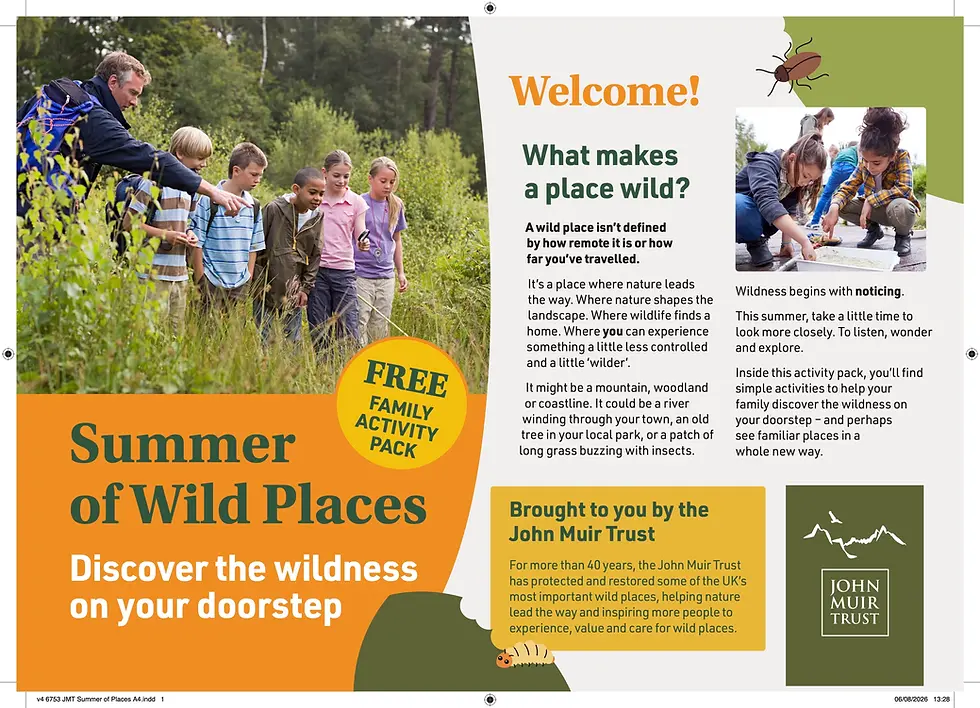
Keeping children entertained through the summer holidays can become expensive very quickly, particularly when every planned day seems to involve tickets, food, parking or travel. The John Muir Trust has now launched a free summer activity pack aimed at giving families something different to do outdoors, without requiring a paid attraction or a long journey.
Its Summer of Wild Places campaign is built around exploring what is already nearby, whether that is a park, garden, beach, woodland or another patch of green space.
That makes this particularly interesting from a money-saving point of view. I recently put together my guide to 30 free and cheap summer holiday activities for children, and some of the best options are the ones where you don't need to buy anything before you start. A walk in the park may not initially sound like a full activity, but giving children something specific to investigate can turn the same familiar place into something very different.
What is in the John Muir Trust’s free family activity pack?
The John Muir Trust has created the free family activity sheet to encourage children and adults to spend more time noticing and exploring the natural world around them. It draws on ideas behind the John Muir Award, with activities centred on looking more closely at natural processes, spotting wildlife and paying attention to what makes a particular place feel wild. The emphasis is on exploring rather than reaching a particular destination, which means the activity can work just as well close to home.
You don't need specialist equipment to get involved, and the campaign isn't asking families to travel to one of Britain's major nature reserves. The Trust specifically suggests places including parks, gardens, beaches, woods and hills, so the starting point could be somewhere you already visit. Its wider John Muir Award resources take the same approach, with the Trust saying wild places can range from wildlife in a back garden or local park to much more remote areas.
That can make a considerable difference to the real cost of a school holiday activity. A supposedly free attraction can stop being free once you've paid for petrol, parking and lunch, while an activity within walking distance can genuinely cost nothing. If your nearest useful green space is further away, it is still worth working out the full travel cost before deciding how far you need to go.
Do you need to travel somewhere properly wild?
No, and that is probably the most useful part of the Summer of Wild Places idea for families watching their spending. The campaign treats a local green space as somewhere worth exploring rather than suggesting that children need a mountain, national park or remote beach before an outdoor trip counts. That opens the activity up to families living in towns and cities as well as those with countryside on their doorstep.
Adventurer and author Alastair Humphreys, who is supporting the campaign, makes much the same point in the launch material, encouraging families to look for adventure close to home rather than assuming they need to travel a long way. The attraction for me from a money-saving perspective is that there is no requirement to turn the activity into an expensive day trip. A familiar park can look very different when children are given a reason to investigate it rather than simply walking through it.
You could also use the same place more than once during the holidays. Weather, plants and wildlife change, so children may notice different things on a return visit even if the route is identical. That gives you another activity without another entrance fee, and it can also create a record of what changed between visits.
How can you turn an ordinary walk into a free activity?
Giving children a purpose can make a normal walk feel much more like an activity. Instead of simply asking them to come for a walk, you can look for different plants, insects, birds, colours, textures or signs of changing weather, then compare what everyone spotted afterwards. The Summer of Wild Places sheet provides prompts to help families slow the pace down and pay more attention to their surroundings.
There are plenty of ways to extend that idea without buying equipment. Children could take photographs on a phone, make drawings when they get home or keep notes about what they spotted on repeated visits. If you already have binoculars, a magnifying glass or an old notebook, take them, but there is no reason to buy a bag of nature equipment simply to complete a free activity.
The Woodland Trust also suggests woodland walks, wildlife spotting and nature scavenger hunts among its summer outdoor ideas for children, while Forestry England has free activity sheets covering subjects such as trees, stargazing and forest crafts. That means you can combine several free resources if one activity isn't enough to fill an afternoon.
How do you keep a free outdoor day genuinely free?
Keeping it local is the easiest way to stop a free activity from accumulating extra costs. If you can walk or cycle to your chosen park or green space, you avoid parking and fuel costs before you've even started, while taking drinks and a packed lunch removes the temptation to buy food while you're out. None of this makes the activity more complicated, it simply protects the £0 idea behind it.
It is also worth resisting the temptation to buy things because they appear to make the day more educational. Children don't need a new backpack, nature kit or specialist clothing to look at trees, bugs or birds in a local park, although sensible footwear and weather-appropriate clothing are important. Use whatever you already have at home first, then decide later whether something would genuinely be useful for future trips.
If you are already travelling during the holidays, take the activity sheet with you rather than planning another paid outing. A campsite, beach, woodland beside your accommodation or even a roadside picnic stop may provide somewhere new to explore without adding another attraction to the holiday budget. The idea works particularly well when it replaces spending rather than becoming another activity added on top.
What is the John Muir Award?
The John Muir Award is the Trust's programme designed to help people connect with and care for wild places. It is based around four stages, Discover, Explore, Conserve and Share, so participants find a place, spend time understanding it, do something that benefits it and share what they have learned. Families and individuals can take part as self-guided participants rather than having to join through a school or organised group.
The current Award is generally aimed at people working at upper-primary learning level and above, although adults are encouraged to take part as well. The Trust says that families can build a self-guided Award around holidays, family outings, volunteering, outdoor hobbies or creative nature activities. Plans need to be submitted before the Award activity begins, and the Trust asks self-guided participants to send their proposal at least two weeks before they want to start.
That makes it more involved than simply downloading the summer activity sheet, so there is no need to commit to an Award just to take part in Summer of Wild Places. If the children become interested in wildlife or conservation during the holidays, it does give you somewhere to take that interest next. A series of family walks or outings can potentially become part of a bigger project rather than ending when the school holidays do.
What difference has the John Muir Award made?
According to figures supplied by the John Muir Trust with the campaign, 6,819 people have completed the redesigned Award since its relaunch last year. The Trust also says participants have dedicated more than 214,000 hours to wild places, with almost 75,000 hours spent on practical conservation work. Those activities have included planting native trees, maintaining paths, removing invasive species and restoring habitats.
The figures show that the Award goes beyond simply spending time outdoors. Conservation is built into the programme alongside discovering and exploring a place, which is why the Summer of Wild Places campaign encourages families not only to notice nature but also to think about looking after it. The Trust's official Award page describes the same four-part approach of Discover, Explore, Conserve and Share.
That doesn't mean your free afternoon in the park needs to turn into a conservation project. For younger children, noticing a beetle, listening for birds or discovering how many different leaves they can find may be enough to make an ordinary walk more interesting. If that interest continues, the Award provides a more structured route for families wanting to do something with it.
Who is the John Muir Trust?
The John Muir Trust is a UK conservation charity focused on protecting and restoring wild places. It cares for places including Ben Nevis, Schiehallion and Sandwood Bay, while also campaigning and running projects intended to help more people connect with nature. Its name comes from Scottish-born naturalist John Muir, whose ideas about wild places went on to have a major influence on conservation.
The Trust's Summer of Wild Places campaign brings that much bigger conservation message down to a very simple family level. You don't need to visit one of the places the charity manages, become a conservation expert or spend money on an organised experience. The starting point is simply noticing what is already around you.
For parents looking at several weeks of school holidays and wondering how every day is going to be filled without spending a fortune, that is probably the most useful part of the campaign. Download the free Summer of Wild Places activity pack, choose somewhere close enough that getting there doesn't wipe out the saving, and see what the children actually notice once they start looking. If it works, keep the sheet and use it somewhere different later in the holidays rather than paying for another day out. Families can download the free Summer of Wild Places activity pack, continue their adventure with the free John Muir Award, and support the charity protecting the UK's wild places via an optional Family Membership from just £1 per month for the first year by visiting: Summer of wild places
Frequently asked questions
Where can I download the free Summer of Wild Places activity pack?
The Summer of Wild Places family activity pack is available free through the John Muir Trust. It is designed to give families simple ideas for exploring nature in places such as parks, gardens, woods and beaches.
Do I need to live near the countryside to use the activity pack?
No. The John Muir Trust says a wild place can include a local park, garden, woodland, beach, hill or other green space, so families do not need to travel to the countryside to take part.
What is the John Muir Award?
The John Muir Award encourages people to Discover, Explore, Conserve and Share their experiences of wild places. Families and individuals can take part through self-guided projects as well as through organisations.
Can families do the John Muir Award themselves?
Yes. The John Muir Trust allows families and individuals to create self-guided Award projects based around places and outdoor activities that interest them, although plans need to be submitted before starting.
What free outdoor activities can I do with children?
A local walk can become an activity by looking for wildlife, noticing different plants, listening for birds or recording what changes from one visit to the next. Parks, gardens, beaches and woods can all provide free places to explore.